

Thanks to this month’s newsletter sponsor, Tea with Tolkien! Check out Kaitlyn’s forthcoming book, Into the Heart of Middle-earth, and be sure to preorder a copy!

Mae govannen, friends! Josh here with a guest post from Stuart D. Brooks. Stuart is a fantasy author close to finishing his first book—The Green-Roofed Tower—which is the first of a planned trilogy (You can read the prologue here).
He is a husband and father who loves to use the poetic language of myth to tell the true tale of the King at the center of the tapestry. Stuart is in love with the Beauty of God, and paints and sells art and merch too.
Today I’m sharing with you all a piece he wrote on The Power of Beauty in Tolkien’s Works. If you like it, you can read further thoughts in a series he is continuing on his Substack, 𝐒𝐨𝐰𝐢𝐧𝐠 𝐖𝐨𝐧𝐝𝐞𝐫.

The Power of Beauty in Tolkien’s Works
by Stuart D. Brooks
After Gandalf fell into the shadow and fire of Moria, the Fellowship was crestfallen.
“What hope do we have without you?” Aragorn mourned.
“We must do without hope.”
Miserable path—
They wept.
Gimli lamented aloud, “Long shall I journey ere I have joy again.”
It is an appropriate thing to say at such a time, but almost immediately something challenged his words.
You see, Gimli sees Durin’s Stone and recalls that Mirrormere is nearby. Despite his misery, even the thought of it sparkles in his eye.
He tells Frodo tale of the magnificent sight—of a lake clear as crystal, gems showing like stars within—or stars like gems? He gets excited about it, for a moment forgetting his grief.
“We cannot pass without turning aside for a moment to look at the wonder of the dale.”
So he and Frodo did. You should go with them:
Frodo followed slowly, drawn by the still blue water in spite of hurt and weariness; Sam came up behind.
They stooped over the dark water. At first they could see nothing. Then slowly they saw the forms of the encircling mountains mirrored in a profound blue, and the peaks were like plumes of white flame above them; beyond there was a space of sky. There like jewels sunk in the deep shone glinting stars, though sunlight was in the sky above. Of their own stooping, no shadow could be seen.
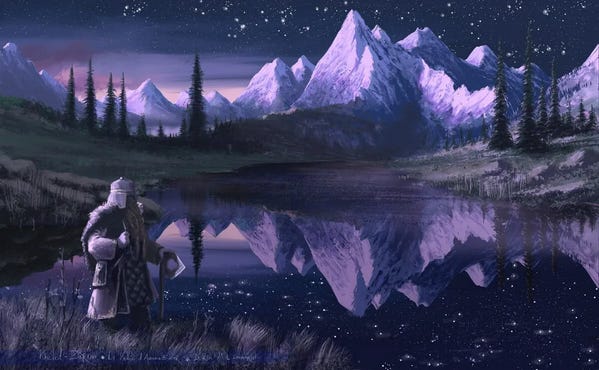
“O Kheled-zâram fair and wonderful!” the dwarf shouted upon seeing the glory.
Now, surely it did not heal the wound of Gandalf’s passing, but it did do something. We do not often think of it, but movement itself is tied to hope.
“All men seek happiness. This is without exception. Whatever different means they employ, they all tend to this end. The cause of some going to war, and of others avoiding it, is the same desire in both, attended with different views. The will never takes the least step but to this object. This is the motive of every action of every man, even of those who hang themselves.”
—Blaise Pascal
All movement seeks happiness, even if unconsciously.
Someone who has dealt with depression will know what I mean. In the deepest despair, there is no movement, for it is a shadow of death. It is cold and still, like Inferno’s deepest ring, all except the endlessly winding wings. There, one only wishes they could want something. Before that lowest ring, one will still move toward what they think will save them. But without hope at all, one finds no reason to leave a bed or to attempt anything, but the smallest hope may stir us if we heed the call of life.
A hope for food, for a shower, the face of a friend, or the Sun on our face—like that voice always calling,
“Lazarus, Come Forth,”
raises back to life.
Despite Aragorn’s fitting word, hope is necessary in order for them to keep moving at all: even if it is a hope so small it is invisible to ourselves. For this dwarf, the desire for beauty moved his feet to step toward joy.
On a subconscious level, to “turn aside” is fundamentally bound to hope. Gimli turned aside after the hope of Beauty, and he found it.
This is the movement of hope and life.
The Fair Paths of Lórien
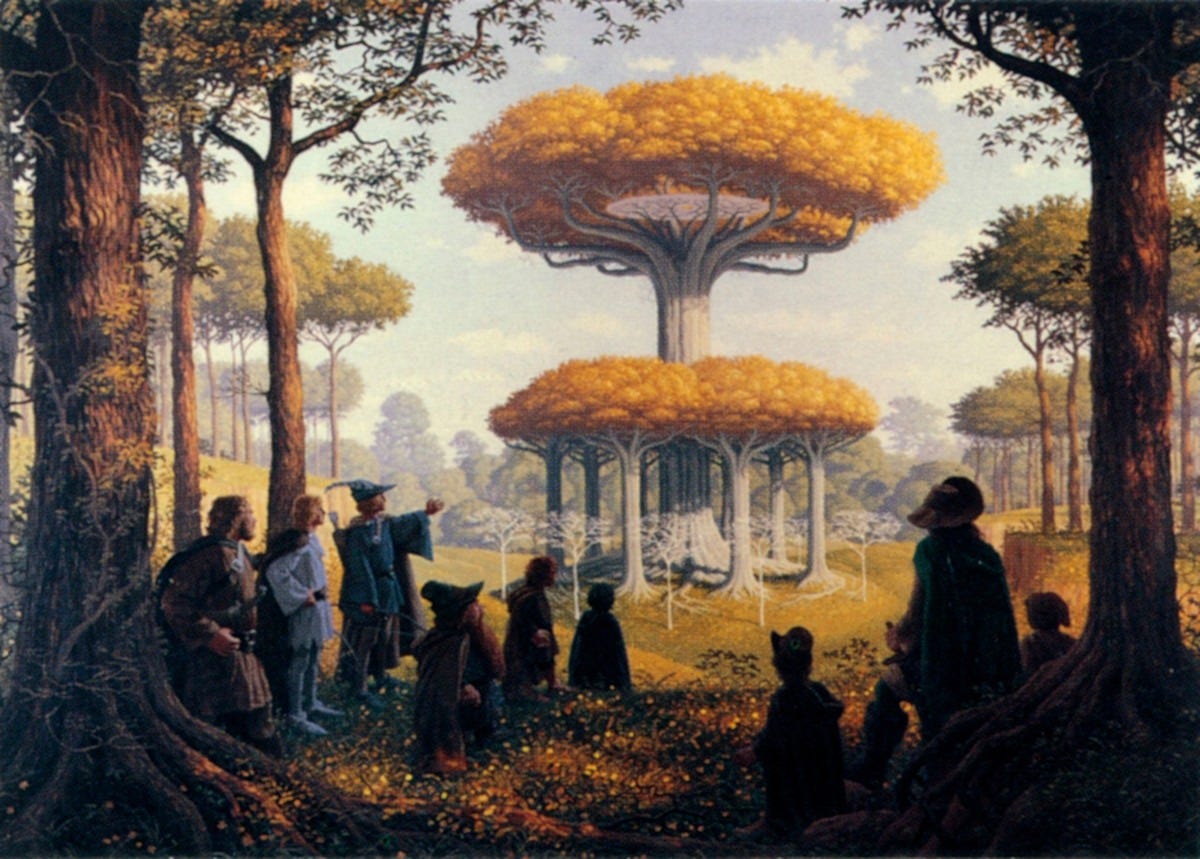
As the Fellowship continues on through the forest, Legolas and Aragorn express the gladness they feel that they will soon see the golden trees of Lothlórien.
Even as they draw near the Silverlode river, they already see preludes to the wonder of Lórien.
Day came pale from the East. As the light grew it filtered through the yellow leaves of the mallorn, and it seemed to the hobbits that the early sun of a cool summer’s morning was shining. Pale-blue sky peeped among the moving branches. Looking through an opening on the south side of the flet Frodo saw all the valley of the Silverlode lying like a sea of fallow gold tossing gently in the breeze.
But before they fully arrive, they have an interesting conversation with Haldir, the elf.
Merry confesses to him that he wonders whether he should have had the heart to leave the Shire at all.
Haldir replies, “Not even to see fair Lothlórien?”
“The world is indeed full of peril, and in it there are many dark places; but still there is much that is fair, and though in all lands love is now mingled with grief, it grows perhaps the greater.”
The encouragement that there is still beauty in the world is fundamentally a statement aimed at hope. It means there is something out there even perhaps worth leaving the Shire for.
It dawns on me then—hope, whether in The Lord of The Rings or here in this place, shines on us through beauty. The fact that beauty exists means that there is hope—that perhaps the future is not dark, but bright—perhaps very bright.
This is where the longing comes in. Like Gimli, suddenly struck with the longing for Mirrormere, we too are moved. Even the thought of distant beauty inspires a movement out of despondency and out infinitely into…
something else.
Tolkien’s good friend C.S. Lewis liked to refer to this longing by a German word, “sehnsucht.” He sometimes referred to it as “joy” since he could not find an English word fitting to the yearning. In a way, however, it hits it right on the head. Joy is the opposite of despondency, after all—and as in Dante’s Paradiso, the ascent into the infinite joy of God is a movement.
It begins when Christ descends as a seed into the tomb of our heart—and then sprouts forth—but the journey is an upward movement toward the Good and the Beautiful. For these are beams of his light, and they are of his source and substance. The movement of life and hope is to follow them home.
So, when Frodo lays eyes on Lórien’s splendor, something deeper, further reaches out from its Beauty.
“Out of it, it seemed to him that the power and light came that held all the land in sway.”
Now, if we ask “From where?” one answer does not suffice. But something about Lothlórien holds power and light over the land, and because of it, Frodo “longed suddenly to fly like a bird to rest in the green city.”
Frodo is drawn out of himself—to follow the Beauty to its heavenly abode.
But when they arrive and come to Galadriel and Celeborn, it is required of them once again to relive and retell the tragedy of Gandalf.
But Legolas says something unexpected.
“We almost forgot our grief for a time,
as we walked in gladness on the fair paths of Lórien.”
Tolkien cast seeds like this one all along these fair paths that we may know and understand the power of beauty—and then at their flowering know the light of Eärendil which calls the weary from Moria.
The Light of Estel
I think it is right to see the ascent from Moria to Lothlórien as something cosmic—to rise from what is a tomb, whatever Gimli says about it—from a haunt of goblins and the domain of a great fiery demon, on up to somewhere heavenly.
Lothlórien is a place where gifts are bestowed on a grief-shaken Fellowship. I think a good way to see Tolkien’s point in this ascent is to see what they came to find there ultimately.
Now, some of the gifts feel like they were given because they did not know what to get them.
“What does Legolas even like?”
“Ehh, well he likes bows and arrows, right?”
Pippin and Mary are given belts of silver leaves, and Boromir a belt of golden leaves. Perhaps this is because their fates were entwined, but honestly, I would be happy with either gift personally. Perhaps they were too.1
Gimli gets three strands of Galadriel’s hair, and he leaves with a surprising and profound devotion to her beauty.
Sam receives a box of good soil and a mallorn seed—for a tree of Lothlórien to plant in his place of choosing. This starts to get at the hope side of these gifts because at the end, Aragorn plants one new tree, and Sam another, echoing the great trees of Valinor which once filled Middle-Earth and gave it light (in the Silmarillion). It is a symbol of a new age and the pattern of a new unplanted beauty.
Aragorn is given a scabbard for Anduril—a permanent home for the sword of the King—and the Elessar gem, a green gem in the setting of a silver eagle. Aragorn is called Elessar by the elves as rightful King, and so it is a symbol of the hope of his return to the throne.
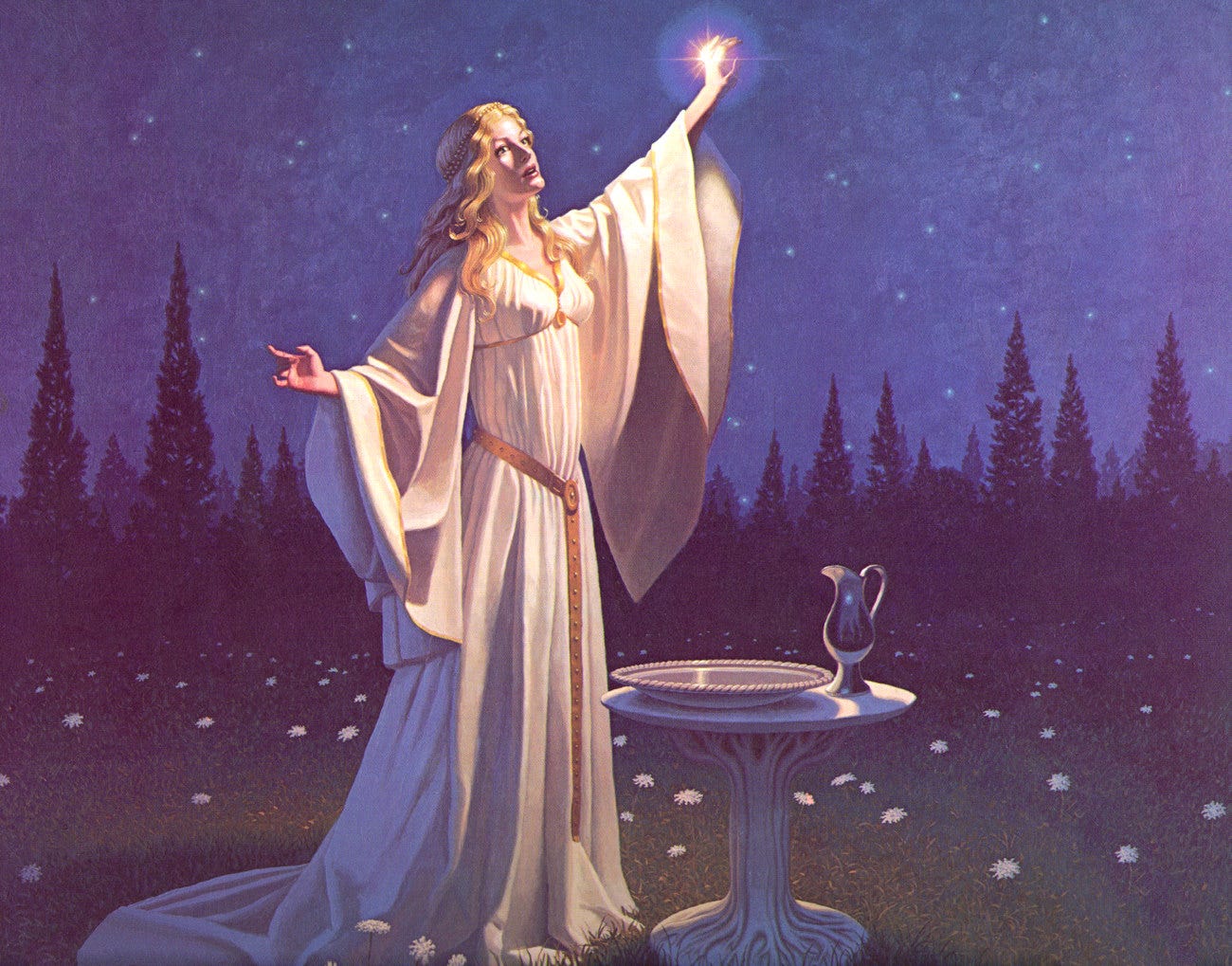
Galadriel herself is a most fair jewel, as the heart of the Beauty of Lothlórien. When Frodo finally comes to her, she gives to him the light of Eärendil.
But what is the light of Eärendil?
It is a long story, but so is Lord of the Rings. It is a good story.
Eärendil, who was Half-elven, once sailed into the heavens on a boat like a swan and placed there in the sky a Silmaril (a gem and the preserved but fading beauty and power of the trees of Valinor).
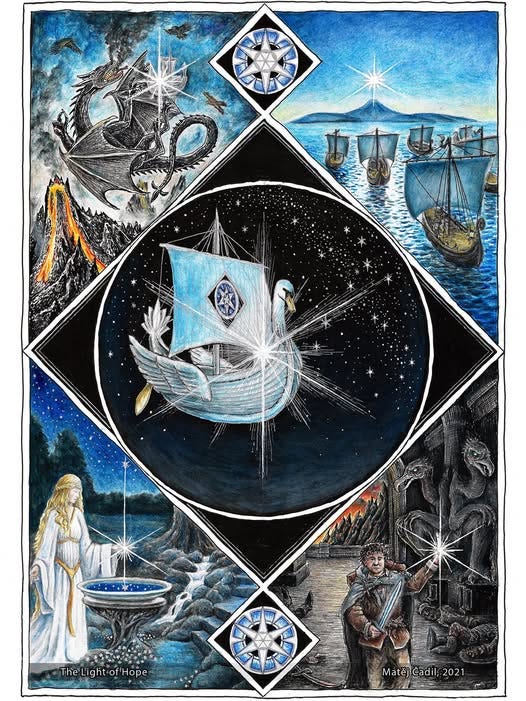
There, the Silmaril stays, as a star called “Gil-Estel, the Star of High Hope.”
Yet the name Gil-Estel itself still has more to give. There is a word for simple hope in Sindarin (grey-elvish), which is called amdir. This is just good expectation.
Estel rather means “trust in Eru the Lord everlasting, that he is good, and that his works shall end in good.”
The phial Galadriel gave to Frodo was made with the light of this star Gil-Estel and the waters of her pool.
“It glittered as she moved it, and rays of white light sprang from her hand.”
Then she told him, “It will shine brighter when night is about you.”
Now, perhaps the light and power of the land was Galadriel’s own, and the ring by which she preserved Lothlórien—but could it have to do with this light—the light of Eärendil? We probably think that anything that can be held in one’s hand is of a limited power or consequence—that, because it is something wielded by us, it must be smaller than us. But this is a shining piece of the original glory—a divine light from above—the shining power of Eru himself.
This, I think may be the light and power Frodo felt in the place called Lórien—something which will later sustain and defend him in his darkest moment.
At the beginning of the fair paths of Lórien, they had to do without hope.
But the movement of the soul toward the inner heart of Beauty is movement of the heart toward hope—a light that shines when the night grows the darkest.
As the fellowship passes the peak of ascent, I believe they leave in swan-shaped boats for a reason.
If they have gone out past the peak of Lothlorien—like Eärendil, sailing on a swan into the heavens—like Dante off the peak into Paradiso—then whatever shadow of death they may pass through, their path is into a good and shining hope forever.
Hey! Thanks for reading! Did you like this post? Then why not subscribe to Stuart's Substack, Sowing Wonder, to get more like it straight to your inbox?
Meat Being Back on the Menu at Cafe Mordor Results in Long Lines and Rave Reviews

MORDOR—Cafe Mordor is experiencing heavier than usual traffic after adding meat back to the menu. Hoping to avoid further confusion and consternation, management would like to remind interested diners that reservations are required in order to guarantee they get …


Interested in writing a guest piece like the above? Check out my submission guidelines and send me a pitch!
Special thanks to Marlon S for becoming a paid subscriber this month! If you too want to help support this newsletterth, consider upgrading today for just $5 a month or $50 a year!
📚 You can read more of my writing by reading my books! My latest is a collection of essays on The Lord of the Rings, The Silmarillion, and more of Tolkien’s works (and their adaptations). You can also find it and more of my books on Amazon or Gumroad
⚔️ If someone forwarded this email to you or you found it through social media or Google, I’d like to invite you to join 15,000+ subscribers in the Jokien with Tolkien community: Subscribe here and get a free gift just for joining!
🏹 Chosen as a Substack Featured Publication in 2023
🪓 Official merch available in the Jokien with Tolkien store
❌ All typos are precisely as intended
🔗 Links may be affiliate, which is a free-to-you way to support this newsletter where I earn a small commission on items you purchase
🗃️ Can’t wait till next week for more content? View the archive
🤝 Want to sponsor a future issue of Jokien with Tolkien? View my rates and packages
It is still interesting that Faramir notices the golden belt in his vision of his dead brother.
Loved this so so much!! The invoking of cold is fascinating to me; life needs warmth to remain alive. That's part of what's so chilling about the Barrow-wights, I think, the deep and resonant cold so starkly contrasting life. Light, warmth, hope, beauty (which light can illuminate)...all beautifully connected, and very intrinsic to us as beings. And the thread of Eärendil's light, originally from the Two Trees...so lovely. I love that Matej Cadil piece!! Thanks again!!