


Happy New Year, all! And Happy Feast of the Epiphany!
This week churches all across the world celebrate the Feast of the Epiphany.1 In the West, this means commemorating the visit of the Magi, or Wise Men, to Jesus and his parents as described in Matthew 2:1-12.
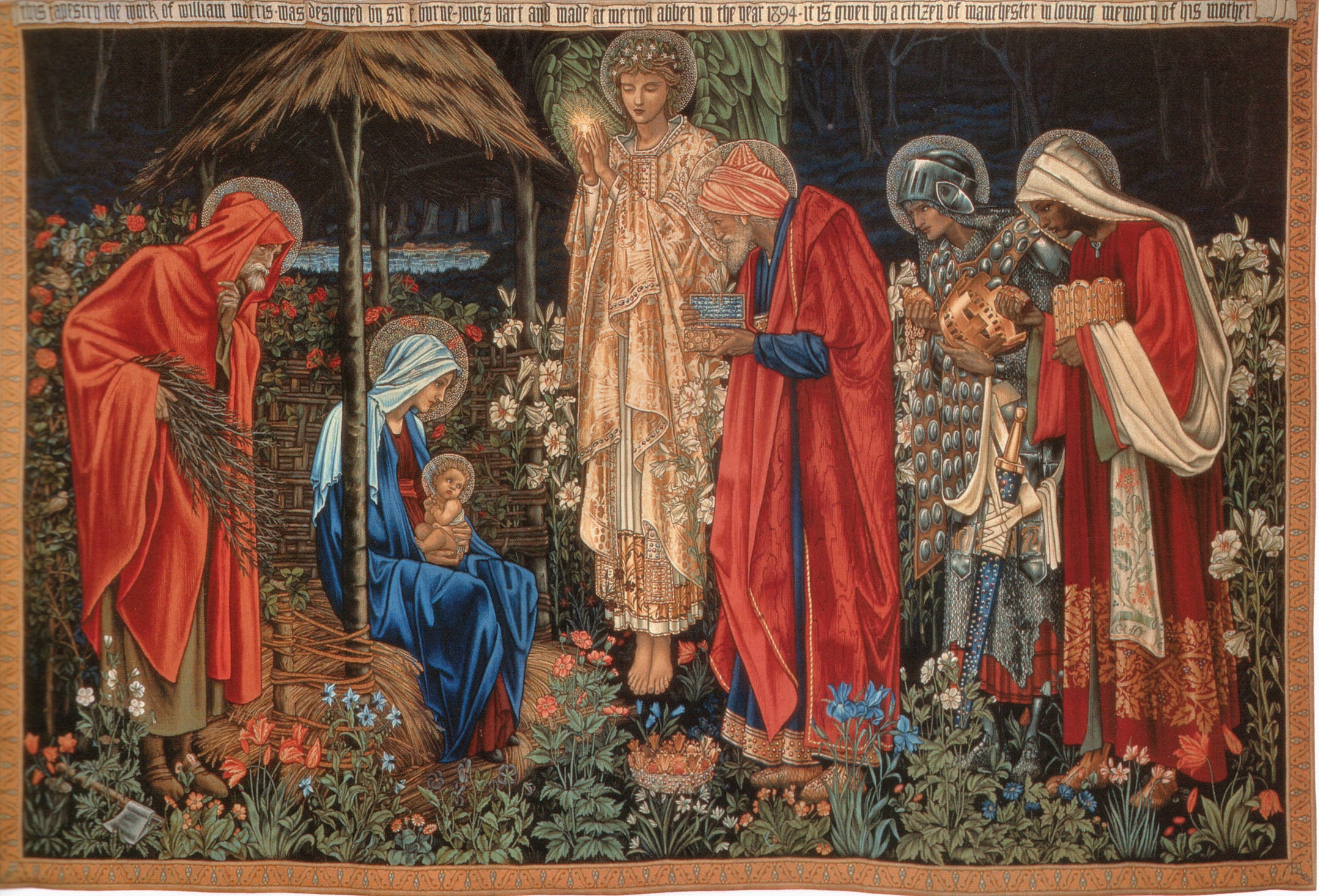
That’s right, they thought the Christmas gifts stopped with the twelve lords a leaping on the twelfth day of Christmas…
but they were—all of them—deceived, for another set of gifts was given.
For on the 13th day of Christmas, when we remember the visit of the Wise Men we also remember the gifts of the Magi. No, not those gifts of the Magi—no pocket watch chain or set of combs for baby Jesus (though he would be equally unable to use them!). It is their gifts of gold, frankincense, and myrrh that we remember.
So enjoy this essay from the archives on gifts in Tolkien and the gifts of the Magi.
The Gifts of the Wise
Gift giving is something of a minor recurring theme in Tolkien’s legendarium. In creating the race of Men and setting them apart from the Firstborn, the Elves, Ilúvatar himself gives his younger children the gift2 of mortality. In the Second Age, Sauron disguises himself in a fair form and gives himself the name Annatar, which means ‘Lord of Gifts,’ while he attempts to sway the elves in Middle-earth to his side. Sméagol demands the One Ring as a birthday gift from his cousin Déagol. Bilbo gifts both Sting and his mithril shirt to Frodo, the latter of which was itself a gift to Bilbo from Thorin. Galadriel gives gifts to the members of the Fellowship upon their departure from Lothlórien.
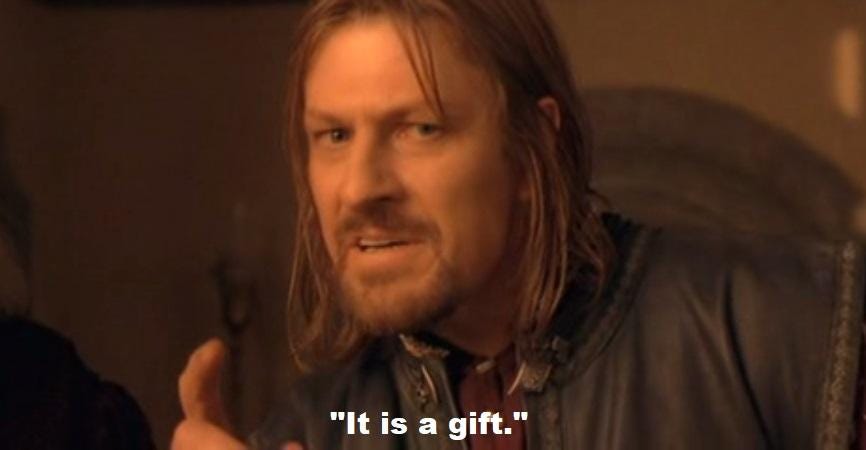
And who could forget this moment from one of the most memeable scenes in the entire film trilogy: Boromir saying of the One Ring at the Council of Elrond, ‘It is a gift.’
To know the true meaning of a gift it is often necessary to know something of the giver as well as something about the recipient. Ilúvatar’s gift of death to men, for instance, is famously difficult to rightly interpret—how can death and not being bound to this plane of existence be a good gift? Knowing more about Ilúvatar as well as the race of men, especially as compared with the elves and their fate, gives some crucial keys to understanding how it could be so. Sauron’s gifts to the elves of knowledge and friendship while he was disguised as Annatar were deceptive, concealing ulterior motives and hiding evil intentions behind fair appearance. Sméagol’s ‘birthday gift’ is no gift at all, and though Boromir was right that the Ring falling into the hands of Frodo is a gift to the Free Peoples of Middle-earth, he was quite wrong about how to wield it.
In particular, the significance of Galadriel’s gift to Gimli of three strands of her hair remains obscured unless you know the history told in The Silmarillion. There we learn of Fëanor’s quest to craft the eponymous Silmarils, wherein he captured the light of the Two Trees of Valinor. Galadriel’s hair was one of his inspirations in his great labor, for it shone gold and silver with the very light of the Two Trees of Valinor. On three occasions he begs her for a single strand of it. Three times Galadriel refuses him. And yet, thousands of years later, she performs a perfect reversal of her initial rejection, giving one strand for each time she denied the gift at the first asking. And not only that, but she gifts these strands to a dwarf, whose people have had bitter blood with elves for centuries.
This was a kingly gift indeed, shocking to those who were aware of her history with Fëanor and functioning as a significant pledge of goodwill between the feuding peoples.
Just as Galadriel’s gift to Gimli is more noteworthy than might be initially understood, many throughout history have also looked for symbolic meanings in the gifts that the Wise Men brought to Jesus.

Special thanks to Richard R, Jenni T, Ed B, and Reed D for upgrading to an Extended Edition membership this past week, and shout-out to Lauren K for becoming a lifetime access member of the Extended Edition!
To join hundreds of members of the Jokien with Tolkien Extended Edition in reading the rest of this full essay (plus over 50 posts in the archives of Extended Edition content), upgrade your subscription today for just $5 a month or $40 a year!
OR for the same price of a monthly membership ($5), get this full essay plus nine more Extended Edition exclusive essays by purchasing my Lore of the Rings Vol. 1 e-book:
This idea that the gifts of the magi are also signs that reveal certain things about Jesus has its roots early in Church History. As early as the second century we have Irenaeus in Against Heresies commenting that the magi
having been led by the star into the house of Jacob to Emmanuel…showed, by these gifts which they offered, who it was that was worshiped: myrrh, because it was He who should die and be buried for the mortal human race; gold because he was a King, ‘of whose kingdom is no end;’ and frankincense, because He was God.3
The ancient roots of this idea endure to the present day. “Joy Has Dawned,” a song written by Keith Getty and Stuart Townsend in 2004, contains the following lines in the third verse:
Gold—a King is born today,
Incense—God is with us,
Myrrh—His death will make a way,
And by His blood He’ll win us.
But do we see these ideas in Scripture generally or in Matthew specifically? Spoiler alert: unlike with Tolkien where our journey took us all the way to The Silmarillion, we won’t have to go very far at all in this pursuit.
Gold for a King
Technically, all three gifts were fit for a king. They were each extravagant, incredibly costly, and out of reach financially for a humble carpenter. But of the three, gold is the most readily connected with royalty. Think of the amount of gold contained in the crowns, swords, orbs, scepters, and rings amongst the crown jewels of the royal families of the monarchies of the world, for instance. It’s clear that gold is associated with status.
By the second chapter of Matthew’s Gospel (where we find the story of the Magi), he has already directly linked Jesus with the kingship of Israel. In the genealogy in Matthew chapter 1, he has already recorded fourteen of the generations from Abraham to David and then fourteen generations from David to the Babylonian exile, followed finally by fourteen generations from Babylon to Jesus. It is no coincidence that both David and Jesus are so prominently highlighted within this genealogy, or that the angel Gabriel addresses Joseph as “son of David” in verse 20 of chapter 1. Finally, Gabriel also tells Joseph that the child shall be called “Jesus, for he will save his people from their sins.” The phrase “his people” points to the idea that these are royal subjects: the people of the King of Israel.
The Messiah was expected to be the heir to David’s throne, a royal king who would rescue his people from their oppressors and troubles. Kingship is a central theme of Jesus’ life and work, for he was born to rule over his people, Israel.
Frankincense to symbolize God’s presence
Frankincense “was an expensive perfume and was burned in worship”4 of deities. It then is reminiscent of Jesus’ divine nature. He was not simply a man or even a king, but God Himself with us.
Matthew has also already clearly connected this idea of godhood with Jesus in the previous chapter, where he said that the circumstances of Jesus’ birth “took place to fulfill what the Lord had spoken by the prophet:
“Behold, the virgin shall conceive and bear a son,
and they shall call his name Immanuel”
(which means, God with us).–Matthew 1:22-23
Jesus' divinity is another central idea to his identity, life, and mission. Born a king, born a divine son of God.
Myrrh for his burial
In John 19:39, Nicodemus comes to the tomb of Joseph of Arimathea to help bury Jesus. He comes “bringing a mixture of myrrh and aloes, about seventy-five pounds in weight.” That’s a lot of myrrh.
Once again we see Matthew has already connected this specific idea with Jesus in the previous chapter. In Matthew 1:21, Gabriel says Jesus will be called Jesus “because he will save his people from their sins.” What will Jesus do for his people? Save them. How will he do this? By conquering militarily, freeing them from the shackles of Rome? By snatching them up and whisking them directly to heaven? No. He will save them through his atoning death on the cross.
Born a king, born God with us, born to save His people, born to die on their behalf.
The gifts of the Magi have distinct cultural and contextual meanings, and each of them is highlighted by Gospel author Matthew in relation to Jesus in the previous chapter. By knowing more about the recipient of the gifts, we can more easily grasp their significance. Born a king, born God with us, born to save His people, born to die on their behalf.
Rather than asking us to do better, try harder, or bring a multitude of gifts to lay at His feet, on the day we remember his birthday, Jesus instead offers to men and women the most precious gift of all: his own life. Unlike Ilúvatar’s gift of death to the race of men, Christ gave Himself in death for men and women. He died in their place so that they might conquer death and live forever. On the Feast of the Epiphany, let us consider not just the gifts of the Magi but the One to whom they were given, and the gift He offers freely to us.
Thank you for being a paid subscriber to Jokien with Tolkien! Your support is so encouraging and affirming! Looking forward to this coming year together.
Like I mentioned in the middle of the essay to free subscribers, this is one of the essays collected in my “Lore of the Rings Vol. 1” book. If you haven’t read it, you get it for FREE just for being a paid subscriber! Download it here:
Leave a rating and review of it (which helps others find it on Amazon) here:
Either today on January 6th, yesterday on Jan 5th, or on another Sunday this month (depending on your tradition)
The ‘Gift’ of Death is also referred to as the ‘Doom of Men’
Irenaeus of Lyons, “Irenæus against Heresies,” in The Apostolic Fathers with Justin Martyr and Irenaeus, ed. Alexander Roberts, James Donaldson, and A. Cleveland Coxe, vol. 1, The Ante-Nicene Fathers (Buffalo, NY: Christian Literature Company, 1885), 423. Alternative interpretations include gold symbolizing virtue, frankincense symbolizing prayer, and myrrh symbolizing suffering, or all three gifts simply being gifts fit for a king but not having any other significance.
France, R. T. The New International Commentary on the New Testament. William B. Eerdmans Pub, 2007.
Beautiful! I like the connection to the LOTR gifts: they offer insights into both the giver and the recipient.