

Entering the Perilous Realm
On Why We Should Read and Reread 'The Lord of the Rings'

My friends at Reading Revisited are reading The Lord of the Rings together with their community this coming year and asked me to share some about why we should be excited to read or reread LOTR, which I gladly did! They published the following short essay on “why read Lord of the Rings?,” but I’m sharing it with you all directly as well.
To find out more about when they’ll be reading LOTR and the other books they will be reading this coming year, visit their 2026-27 schedule.
Entering the Perilous Realm
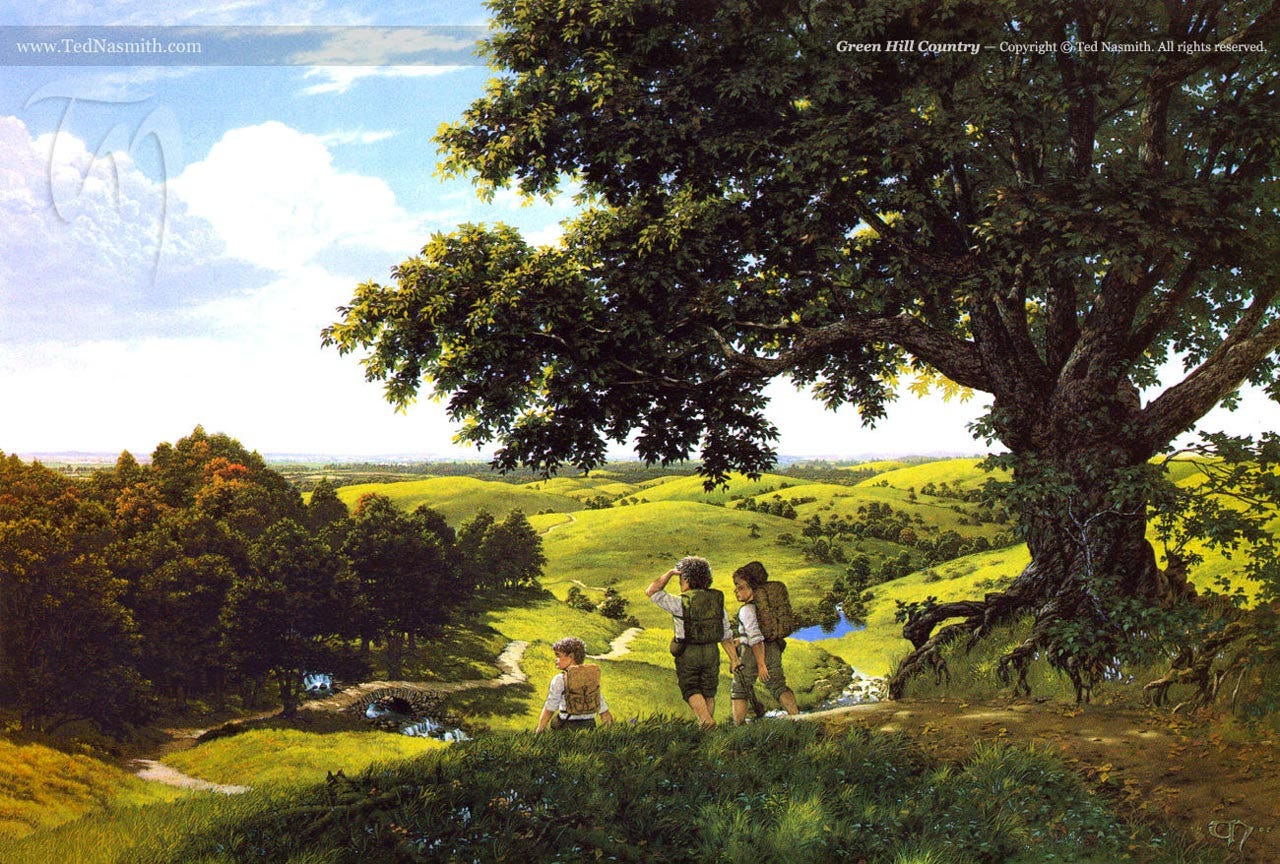
Towards the beginning of The Lord of the Rings, Hobbits Frodo, Sam, and Pippin travel through the Shire. As they pass through the idyllic countryside and approach the Brandywine River, they recognize that this boundary marker symbolizes more than just the physical border of their home country of the Shire: it represents the end of the familiar, of the known. Beyond lies new lands, excitement, and danger.
Staring off into the distance, Frodo thinks of his uncle, Bilbo Baggins, who had a great adventure many years ago when he got caught up with some business with a dragon and dwarves and a kindly wizard named Gandalf. Though he was considered a highly respectable Hobbit before that adventure, he returned a changed halfling. His reputation among his fellow Hobbits never quite recovered.
Frodo shares the following advice that Bilbo passed on to him with Sam and Pippin:
It’s a dangerous business, Frodo, going out of your door…You step into the Road, and if you don’t keep your feet, there is no knowing where you might be swept off to.1
Something similar might be said for picking up a good book: it’s a dangerous business, opening the cover of a book. You turn to the table of contents or first chapter, and if you don’t keep your feet, there is no knowing where you might be swept off to.
Why read Tolkien’s The Lord of the Rings, though? Why choose this particular fork in the road to explore, whether for the first time or the hundredth?
It will almost certainly come as no surprise to you, dear reader, to hear that The Lord of the Rings is both one of the most popular and influential books of the twentieth century. Tolkien was crucial to the development of “Fantasy” as a modern genre–illustrated perhaps no better than in the organization of the “History of Fantasy” article on Wikipedia, which divides its section on Modern Fantasy into three sections: “Pre-Tolkien,” “Tolkien,” and “Post-Tolkien.” Tolkien also helped rescue the “fairy-story” as he called it from relegation to the children’s nursery. Fantasy author Terry Pratchett, who was himself a giant of the fantasy genre, once compared Tolkien’s influence on fantasy to that of Mt. Fuji in Japanese art:
J.R.R. Tolkien has become a sort of mountain, appearing in all subsequent fantasy in the way that Mt. Fuji appears so often in Japanese prints. Sometimes it’s big and up close. Sometimes it’s a shape on the horizon. Sometimes it’s not there at all, which means that the artist either has made a deliberate decision against the mountain, which is interesting in itself, or is in fact standing on Mt. Fuji.
Having conquered the realm of fantasy, The Lord of the Rings moved next to a far stranger and more exotic realm: pop culture.
The Lord of the Rings was embraced by the American hippie and anti-war counterculture of the 1960s and 70s, but it conquered mainstream culture with the release in the early 2000s of Peter Jackson’s Lord of the Rings film trilogy. These films have earned roughly $3 billion total and received a total of 17 Academy Awards, achieving the rare balance of critical and commercial success.
But The Lord of the Rings can’t possibly be that good, can it? Surely it’s overhyped? Can’t live up to all it is promised to be? Isn’t as good as you remember when you first read it at twelve years of age?
It is rare indeed to find something in this world that delivers on all the hype and lives up to the promises of nostalgia and/or near-universal acclaim. Nevertheless, I can confidently recommend The Lord of the Rings as one of those rare treasures that is as good as everyone says it is, that is as wonderful as you remember it being.
But even all these reasons are not the real, true, or best reason you should read The Lord of the Rings.
Read The Lord of the Rings because, like all other great literature, it has both the power to transform you and the depths to reward you for revisiting it time and time again.
In his seminal work “On Fairy-Stories,” Tolkien analyzes the form and the power of fantasy, or fairy-stories, which are tales concerned with the realm of Faëry. Tolkien uses a fascinating term to describe Faery, calling it “the Perilous Realm.” Why is Faëry “perilous?”
While there are many potential answers to this question, I will content myself with examining just one: the realm of Faëry is a realm that leaves no traveler unchanged. We see this power in The Lord of the Rings itself during a conversation between two members of the Fellowship of the Ring from the kingdom of Gondor: Boromir, captain of Gondor, and Aragorn, Ranger of the North.
Speaking of the Elven realm of Lothlórien, Boromir shares: “Of that perilous land we have heard in Gondor, and it is said that few come out who once go in; and of that few none have escaped unscathed.”
“Say not unscathed, but if you say unchanged, then maybe you will speak the truth,” replies Aragorn.2
The men of Middle-earth know, from both legend and personal experience, that to enter the realm of Faëry is to submit yourself to a transforming power.
What is true of journeys into Faëry for the characters within the stories is also true for those of us who journey through the realms as readers. We cannot presume to be immune to the power of Faëry, so in light of the peril within, I will end this recommendation of J.R.R. Tolkien’s The Lord of the Rings with a series of warnings.
Do not venture into Tolkien’s Middle-earth if you wish to remain unchanged. In the pages of The Lord of the Rings you will encounter joy and sorrow, beauty and evil, power and ruin. You will meet heroes great and small and encounter evils both monstrous and mundane. And these encounters with the Fey will challenge you, encourage you, burden you, and smite your heart.
In the pages of The Lord of the Rings there is darkness and danger, but there is light and high beauty that glimmers from a realm beyond, beckoning you to have courage in the here and now.
Do not venture into The Lord of the Rings if you want mere escapism. Tolkien himself in “On Fairy-Stories” contended that escape was one of the essential functions of fantasy. But it is not the only function fantasy can play.
Yes, fairy-stories offer escape. But they also offer us a glimpse of truth that we could perhaps not see (or had forgotten) save for this journey into the Perilous Realm. Writing about fairy-stories, Tolkien says:
It is the mark of a good fairy-story, of the higher or more complete kind, that however wild its events, however fantastic or terrible the adventures, it can give to child or man that hears it, when the “turn” comes, a catch of the breath, a beat and lifting of the heart, near to (or indeed accompanied by) tears, as keen as that given by any form of literary art, and having a peculiar quality.
If you’re anything like me, I know that you might be in need of an encounter with the good, the true, and the beautiful, of a glimpse of something that moves you, that inspires you, that gives you hope. Look no further: the road is before you. Will you let yourself be swept off into the Perilous Realm?
For Extended Edition Members
Special shout out and thank you to Dagor D for upgrading to a paid membership this week!
For Discussion
What are the reasons you come back again and again to The Lord of the Rings? And/or what brought you to the realm of Middle-earth in the first place?

📚 You can read more of my writing by reading my books! My latest is a collection of essays on The Lord of the Rings, The Silmarillion, and more of Tolkien’s works (and their adaptations). You can also find it and more of my books on Amazon or Gumroad
⚔️ If someone forwarded this email to you or you found it through social media or Google, I’d like to invite you to join 17,000+ subscribers in the Jokien with Tolkien community: Subscribe here and get a free gift just for joining!
🏹 Chosen as a Substack Featured Publication in 2023
🪓 Official merch available in the Jokien with Tolkien store
❌ All typos are precisely as intended
🔗 Links may be affiliate, which is a free-to-you way to support this newsletter where I earn a small commission on items you purchase
🗃️ Can’t wait till next week for more content? View the archive
🎯 Interested in writing a guest piece? Check out my submission guidelines.
🤝 Want to sponsor a future issue of Jokien with Tolkien? View my rates and packages
J.R.R. Tolkien, The Lord of the Rings, Book I, Chapter 3, “Three is Company”
J.R.R. Tolkien, The Lord of the Rings, Book II, Chapter 6, “Lothlórien.”
I can’t remember specifically what brought me to the realm of the Lord of the rings, but I think it was the animated movie The Hobbit. I remember seeing that movie when I was very young, long before I ever read the books. And it has always stayed with me. It’s probably why I’ve always wanted to write fantasy stories myself.
As one of those who encountered the trilogy in the sixties and seventies, i find that it has become a reference for interpreting the present. As I read it again with the knowledge of what will come next in the story, it gives me a kind of clarity and light and hope that I bring back into a cloudy world.